 antics of my family: at a homebrew party I threw a couple of years ago, underneath the list of beers they began adding their own beer names. When someone asked me where the Peculiar Wang Ale was, they all started giggling like schoolgirls. Ah, family. So Morgan, John, Jason, and Sean, this beer is for you. And since the the Old Ale recipe is a big one, I’m making a small beer to maximize my brewing enjoyment.
91. Peculiar Wang Old Ale
Mash:
14 lbs. Thomas Fawcett Maris Otter
12 oz. Breiss Special Roast 6-row 50° L
8 oz. Breiss Caramel 6-row 60° L
4 oz. Muntons Dark Crystal 2-row 135-165° L
4 oz. Weyerman CaraWheat
3 oz. Simpsons Black Malt
2 oz. Weyerman Chocolate Wheat
1 oz. Simpsons Roasted Barley
Mashed @ 154° F for 90 minutes w/5 gallons of distilled water; 2 ¾ gallons of 1.080 wort (@ 150° F)
Batch sparged @ 166° F for 20 minutes w/4 gallons of distilled water; 4 ¼ gallons of 1.030 wort (@ 145° F)
Collected 7 gallons, brought to a boil (90 minutes) and added:
5 g. gypsum
1 lb. Turbinado cane sugar
w/60 to go: 1 oz. Magnum pellet 10.0% AA
.7 oz. Galena pellet 14.1% AA
.25 oz. Tettnang pellet 4.7% AA
.25 oz. Cascade leaf 7.5% AA
w/15 minutes to go: 1 tsp. Irish Moss
w/10 to go: 1 lb. (454 g.) Lyle’s Black Treacle
Chilled and racked to carboy on Wyeast 1056 American Ale cake from 90. Session IPA
Brewed: 5/30/2011 @ 72° F; free rise to 78° F over the course of 12 hours, with vigorous fermentation after 6 hours
Secondary: 6/15/2011 @ 1.020
Bottled: 7/15/2011 w/ 2.4 oz. table sugar at 70° F
OG: 1.088
FG: 1.018
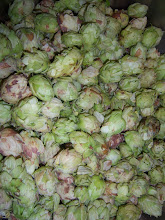
91a. I had an extra half-gallon of wort left, so I put it in a growler and pitched Wyeast 1968 that was on hand; I racked it onto 1 lb. of Bing cherries (6/29/2011), then bottled it with .35 oz. table sugar and US-05 to re-yeast (9/22/2011).
91b. Pulled ½ gallon from secondary; put it on ½ lb. frozen ground cherries (6/29/2011), then bottled it with .35 oz. table sugar and US-05 to re-yeast (9/22/2011).
Tasting Notes (4/26/2011): Morgan Lewis’s Peculiar Wang has, sadly, still not carbonated, which means it probably never will; there is a slight hiss when the bottle is opened, but nothing beyond that. The underlying beer is interesting, but without the carbonation, it is a bit muddied and indistinct—I’ll be interested to more explicitly compare it with the two ½ gallon batches I put on fruit.  The beer pours a rosy caramel chocolate and is flat and clean across the surface; there are some orange highlights in the glass and on the table through the glass. Aromas start with chocolate, rum raisin, and dark fruit, including cherry, fig, and dried fruit. I get something reminiscent of a tannic oak sharpness, which, since I used no oak, is odd—my best guess would be this is from the treacle. Flavors open with caramel and treacle—it almost has a pine and peaty character to it, or something similar that I lack the descriptive vocabulary to locate—before transitioning into a clean and dry middle that has vinous and slight oxidized cardboard notes. Again, I’d note something of a tannic oak bite and flavor, although I have no clear sense where the flavor is from, unless it is a combination of the treacle and slight oxidized flavors. I also get hints of the dark fruit from the nose in the front and middle, but much less evident in flavor than aroma. There is a touch of bread dough chewiness before ending with treacle, molasses, and brown sugar with a touch of paper.
  As the flavors indicate, the beer has also started to pick up some vinous and oxidized notes—I’m guessing that the lack of carbonation allowed the small bit of oxygen in the head space to speed up this process. Again, nothing over the top, but it is more prominent in a flat beer, and it increases the dryness on the palate. The body is medium, but dry—it does suck a bit of the moisture out of the mouth, but not in an overbearing way—it does strike me as distinctly British. There is, however, a touch too much alcohol—it is more in the flavor than in the heat, but again, it is within the parameters of the style. When I do this beer again, I want to raise the mash temperature 2° to 156° F and go for a colder fermentation; it doesn’t need more sweetness (I’d also cut the treacle in half—it is good, but dialing it back a notch might improve the malt character), but a touch more body would round the beer on the palate, especially if the carbonation comes through. The strength is the caramel flavor and complexity—via the treacle—and the developing oxidized notes. The lack of carbonation is a big problem. I might have to buy one of those carbonation caps for a plastic soda bottle, and make Jeffrey carbonate it for me to see what it would be like otherwise. Chock this up to lessons learned.
 The beer pours a rosy caramel chocolate and is flat and clean across the surface; there are some orange highlights in the glass and on the table through the glass. Aromas start with chocolate, rum raisin, and dark fruit, including cherry, fig, and dried fruit. I get something reminiscent of a tannic oak sharpness, which, since I used no oak, is odd—my best guess would be this is from the treacle. Flavors open with caramel and treacle—it almost has a pine and peaty character to it, or something similar that I lack the descriptive vocabulary to locate—before transitioning into a clean and dry middle that has vinous and slight oxidized cardboard notes. Again, I’d note something of a tannic oak bite and flavor, although I have no clear sense where the flavor is from, unless it is a combination of the treacle and slight oxidized flavors. I also get hints of the dark fruit from the nose in the front and middle, but much less evident in flavor than aroma. There is a touch of bread dough chewiness before ending with treacle, molasses, and brown sugar with a touch of paper.
  As the flavors indicate, the beer has also started to pick up some vinous and oxidized notes—I’m guessing that the lack of carbonation allowed the small bit of oxygen in the head space to speed up this process. Again, nothing over the top, but it is more prominent in a flat beer, and it increases the dryness on the palate. The body is medium, but dry—it does suck a bit of the moisture out of the mouth, but not in an overbearing way—it does strike me as distinctly British. There is, however, a touch too much alcohol—it is more in the flavor than in the heat, but again, it is within the parameters of the style. When I do this beer again, I want to raise the mash temperature 2° to 156° F and go for a colder fermentation; it doesn’t need more sweetness (I’d also cut the treacle in half—it is good, but dialing it back a notch might improve the malt character), but a touch more body would round the beer on the palate, especially if the carbonation comes through. The strength is the caramel flavor and complexity—via the treacle—and the developing oxidized notes. The lack of carbonation is a big problem. I might have to buy one of those carbonation caps for a plastic soda bottle, and make Jeffrey carbonate it for me to see what it would be like otherwise. Chock this up to lessons learned.
___________________
92. Small Wang Pale Ale
Third runnings from 91. Peculiar Wang Old Ale
Mashed @ 157° F for 45 minutes w/4 gallons of distilled water
Collected 4 ¼ gallons of 1.016 wort, brought to a boil (90 minutes) and added:
3 g. gypsum
½ lb. Turbinado cane sugar
w/60 to go: ¾ oz. Simcoe leaf 14.1% AA
w/15 minutes to go: 1 tsp. Irish Moss
w/10 to go: ½ oz. Centennial leaf 11.5% AA
w/5 minutes to go: ½ oz. Simcoe leaf 14.1% AA
w/0 minutes to go: ½ oz. Centennial leaf 11.5% AA
Chilled and racked to carboy (3 gallons); pitched on starter made from the dregs of a Jolly Pumpkin Bam Biere on 5/19/2011
Brewed: 5/30/2011 @ 70° F
Secondary: 6/22/2011 @ 1.002
Bottled: 7/15/2011 w/ 2.75 oz. table sugar
OG: 1.032
FG: 1.002
Tasting Notes (12/14/2011): While this beer got hopped like a pale ale, the remaining malt and yeast character pretty much takes that style out of the running. It pours a crystal clear dirty orange/taw
 ny color with a thin tan head. Aromas are musty and lightly tart with a touch of barnyard—it has more going on in the nose than 97, and is lighter in color. In regards to flavor, the front is a dry husky malt that leads into musty funk; the middle is chalky and tart—it reminds Elli and I both of Smarties (the rolled candies, not the Canadian rip-off M ’n’ M’s)—which leads into the finish that is a mix of what I would call goat-y (for lack of a better term) and bitter, which seems to be the o
 nly remainder of the hops. The bitterness is clean and dry, and lingers with the funk on the palate. The carbonation is bright and spritzy on the tongue, but is also dry and flat. There is also a slight touch of cardboard, but I don’t believe it is from oxidation—rather, the yeast has just consumed almost every possible bit of sugar, leaving the dry residual grain flavors behind, but not much else. For example, I can taste the Breiss Special Roast as one of the lingering astringent flavors in the middle and on into the finish. I like this version better than 97, but they both mainly serve as experiments confirming the need for a lighter malt bill. Well, that, and the need to make more small beers. But who doesn’t know that already?

 Elli
Elli


