Monday, September 17, 2012

Wild Wet Hop Brewday

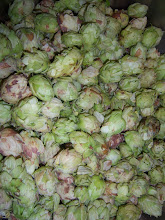
Two years ago, I made a Wild Wet Hop beer using hops I found growing on the local bike path. I missed out on the wild hops last year, so I was excited to see that this year was a bumper crop for those delightful green devils—Elli and I picked a little over three pounds on Sunday, and we didn’t even put a dent in what was out there. I held out on using all of them in this beer, which was a good idea, since the two pounds of fresh hops I did use took up more space in the boil kettle than I expected. I plan to head out again Thursday to pick another couple of pounds to use in another Wild Wet Hop beer—this one with coffee, ala the Press Black IPA experiments from earlier in the year. So many hops! And so little time!

127. Wild Wet Hop 2012
Mash:
8 lbs. Weyerman Pilsner
2 lbs. MFB Vienna

Mash @ 153° F for 65 minutes w/ 4 gallons of RO water & 2 g. gypsum; collected 2 ¾ gallons @ 1.070
Batch sparge @ 166° F for 20 minutes w/ 4 gallons RO water & 2 g. gypsum; collected 4 gallons @ 1.024

Collected 6 ¾ gallons; brought to a boil (60 minutes), & added:
w/60 to go: 8 oz. wild wet hops

w/15 to go: 6 oz. wild wet hops
1 tsp. Irish Moss
8 oz. table sugar

w/10 to go: 6 oz. wild wet hops

w/5 to go: 6 oz. wild wet hops

w/0 to go: 6 oz. wild wet hops

Chilled, racked to carboy, & pitched Wyeast 1332 Northwest Ale

Brewed: 9/17/2012

Secondary: 9/28/2012 @ 1.012; dry hop w/ 2 oz. wild hops (frozen)
Bottled: 10/4/2012 w/ 3.0 oz. table sugar

OG: 1.050
FG: 1.010

Tasting Notes (11/10/2012): Wild Wet Hop pours a slightly hazy soft gold with a prolific and dense white head. It is clear enough to see the streaming bubbles inside the glass, which offers a nice visual effect when held up to the light. The nose is mainly bread crust mixed with grass, hay, and a slight spiciness that is part pear and apple; it does start to veer into a vegetal and chlorophyll aroma, which is probably in part from the two pounds of wild wet hops that went into this: that might have been a bit of overkill. Flavors start with bread crust and a touch of apple; there is a touch of the grass and chlorophyll, but further back. The middle is lightly spicy with more of a green apple bite, which lingers into the finish. There is toast and a fair amount of spritzy spiciness in the finish, although the beer finishes bright and clean with a touch of lingering hay and grass. The light body and spritzy carbonation works well with the beer—this worked well in trying to create a beer that allows the light delicate flavors of the wild hops to shine through. I’m going to call the beer a moderate success, although I am guessing most people are going to complain about the vegetal flavor and ignore the delicate pear, apple, and spicy flavors playing across the profile of this beer. Two main things to improve this next time around: cut the overall volume of hops, specifically the 60 minute addition, and collect them later—in going for still green and colorful hops, I may have erred on the side of young—the flavor from the last version is in this beer, but it has a more vegetal and green taste to it. Oh, and dry hopping with frozen hops: bad idea. Dry them out first. I’m not sure how much the vegetal flavor is a product of the dry hopping with frozen hops, but it did taste much better going into the secondary (i.e. prior to dry hopping) than it did going into the bottle. Lesson learned.

Saturday, September 15, 2012

Dayton DRAFT Brewfest Judging 2012

Ah, Brewfest. That time of year when I get to lay claim to the second bottle of every one of Jule Rastikis’ beers that didn’t make it to the BOS. And believe me, since the perks of being Cellar Master are few and far between, I make use of my marginal powers every time I can. Thus, all four of Jule’s beers are now safely tucked in my refrigerator at home. Don’t worry—you’ll be hearing about them sometime soon.

Bacon Cheesecake courtesy of Scott Young

This year’s event had a bit smaller of a turnout than in previous years: we ended up with 168 entries in total, broken into 15 flights. As noted, I foolishly agreed to be the Cellar Master again, but the sweet siren call of Rastikis made it impossible to say no. Everything went smoothly, and—shockinginglyest of all—we actually started on time at 9:00 am. We also might have even finished a little bit early. It was almost like we knew what we were doing. Then again, let’s not get too crazy. I was pleased to see that my Scottish 80 Schilling—the Edinburgh version from the 80 Shilling Yeast Experiment—did as well as it did in the overall judging. I’d also like to pillory Ashley for not knowing what a Belgian Quad is, but we all know the parable regarding the beating of a dead horse, and, well, that horse is dead. Even if Ashley was the one who killed it. Oh, and the overall results are listed here.

Thanks to all of the out of town judges who made the time to come to Dayton and help us out. I can’t speak for everyone, but I know I’ll be happy to return the favor. Thus, I know where I’ll be on October 20th. That’s right—enjoying the rotating restaurant in the Covington Radisson. Slow revolutions are the best revolutions.

(9/15/2012)

Saturday, September 8, 2012

Dayton Art Institute Oktoberfest Beer Judging

Today was a quick round of beer judging for the Dayton Art Institute’s Oktoberfest—I was coerced by Jeffrey to participate, even though I was trying to get ready for tomorrow’s Frankenbike, which, while not beer related, is ever so much more potentially painful and scarring. And by that, I mean good. Painful yes, but good. Anyway, flights were small and quick: Jeffrey & I (yes, we were paired together to judge) rolled through Alts, Oktoberfests, English and Imperial IPAs, and part of the Specialty Beers category. Some good beers, and also some bad ones, but all in all a good time. That Midnight Sleigh Ride was a fantastic voyage. And an easy point on the day, unlike this coming weekend. For all the results, see here.

Highlight of the day: writing on a score sheet that the malt profile of an English IPA tasted “too American,” and then finding out that it was Chris Wyatt’s beer. Ah, the deliciousness. For those of you that don’t get the joke, Chris Wyatt is—how to best put this?—proudly and unabashedly British. As in from England. And for those of you who still don’t get the joke, well, too bad. I’d offer to draw you a diagram, but since I don’t really mean it, that’s just bad faith. Coming from the man whose comedy touchstone is the enjoyment he finds in explaining his own jokes, that’s saying something. And if you don’t get the concept of bad faith, then you’re probably a Republican. Can I get an amen?

(9/8/2012)

Friday, September 7, 2012

The Session #67: How Many Breweries in 2017?

As Derek notes in the the announcement to this Session, “the latest brewery numbers recently released from the Brewer’s Association, [...] counted exactly 2,126 breweries in the United States. To put that into context, you have to go way back to 1887 when the United States had that many breweries. It’s an astonishing 47% increase from just five years ago in 2007 when the tally was a mere 1,449, despite the United States slowly recovering from a serious recession over this period. And according to the Brewers Association, another whopping 1,252 breweries are in the planning stages.” To clear everything up, I can tell you that there will be 2589.5 breweries in the United States in 2017. The half is to prevent ties. 

If I were to base my guess on what is happening in Dayton, OH, the town I live in, I’d actually have to go a lot higher. When I moved here in 2006, there was nothing in terms of local breweries. While there was a fantastic German-American brewing history, and there had even been some recent attempts and failures prior to my arrival, no one was up and running when I showed up on the scene. All that should change shortly. Currently, there is one small brewery that has recently opened, Dayton Beer Company, as well as several others that are in the planning stages: Yellow Springs Brewery, Toxic Brew Company, Fifth Street Brewpub (which is planned as a co-op collective, and yes, I am a member), Eudora Brewing Company, and Vitruvian Brewing Company. There may be more I don’t know about as well. Will they all actually end up open? I don’t know. Can they all survive? Again, you’re probably asking the wrong guy. But I will say that it is exciting to hope. I do think that higher numbers are sustainable, albeit with at least one big caveat: it will depend upon how these breweries market themselves on the local scale. I do think that 3-4 local, small scale breweries can be sustained within a city the size of Dayton, specifically if there is not cutthroat competition by one or more to take over and drive the others out. If growth becomes the model that these breweries pursue, however, I would expect to see the numbers drop, not only locally, but nationally—I think that the caveat I am offering here plays well beyond the Dayton region limits. I would like to imagine Dayton—and the United States writ large—with more local, fresh, and most importantly good, beer. And while I understand that markets dictate a need to sell beer as a product, the dream of becoming the next big thing is certainly not sustainable with the numbers provided by the Brewer’s Association. Then again, I read books for a living, so what the hell do I know?

The Session is a monthly first Friday beer blogging event; this month is hosted by Derek Peterman at Ramblings of a Beer Runner. Drink and blog, y’all.

Can I have my winning beer now, Derek?
 
(9/7/2012)

Tuesday, September 4, 2012

Saison w/ Comet Brewday

Time for more saison, the beer that, if he were still alive today, Jesus would be hitting up like Mark McGwire takes out fastballs. Simile me some of that. And yes, I’m calling Jesus a drinker. Water to wine? Puh-lease. I don’t think so. More like water to sweet sweet saison magic. After all, saison saves, just like Jesus. Indubitably.

125. Saison w/Comet
Mash:
6 lbs. MFB Pale
2 lbs. MFB Vienna
2 lbs. Breiss White Wheat

Mash @ 149° F for 90 minutes w/ 3 ½ gallons of RO water & 2 g. gypsum; collected 2 ¼ gallons @ 1.074
Batch sparge @ 166° F for 20 minutes w/ 4 gallons RO water & 2 g. gypsum; collected 4 gallons @ 1.026

Collected 6 ¼ gallons; brought to a boil (60 minutes), & added:
w/60 to go: 1 oz Comet leaf 11.0% AA

w/15 to go: 1 oz. Comet leaf 11.0% AA & 1 tsp. Irish Moss

w/5 to go: 1 oz. Comet leaf 11.0% AA
8 oz. table sugar
4 g. crushed coriander
2 g. crushed seed of paradise

w/0 to go: 1 oz. Comet leaf 11.0% AA

Chilled, racked to carboy, & added East Coast Yeast ECY08 Saison Brasserie from 125. Saison w/ EKG

Brewed: 9/4/2012
Secondary: 9/22/2012 @ 1.002; dry hop w/ 1 oz. Comet leaf 11.0% AA
Bottled: 10/4/2012 w/ 4.0 oz. table sugar

OG: 1.052
FG: 1.002

Tasting Notes (11/22/12): Saison with Comet pours a lightly hazy dull gold with a pillow-y white head; there are streams of small, tight bubbles streaming up the sides of the glass. The nose is spicy resin and citrus; I get orange marmalade and lemon zest along with a touch of grassy hay, plus a whole bunch of other subtle fruit hints—grapefruit, passion fruit, mango. There are also plenty of yeast esters that round the nose and make it delightful: I’m really not sure which aromas are from the hops and which are from the yeast. There is a reason I’ve drank pretty much all of this beer already. Flavors mirror the nose, although there is a slight cracker malt flavor in the front, along with a touch of candy sweetness from the Vienna. But other than that, the hop flavors match the nose, with spiciness in the front and citrus in the middle and finish. The beer is dry and cracker-y on the palate, both from the well attenuated body and the bright, spritzy carbonation. There is a touch of a mineral bite, but it blends in seamlessly with the hop bitterness: both are bright and cleansing. While this beer is something of a bastard in form—it combines a saison body with American craft beer levels of hopping—it hits right in my sweet spot. I think this beer is phenomenal—it is easily the best thing I’ve made in a long time. So not only does this mean that I love East Coast Yeast more than I did already, it means that Comet is the real deal as a hop, and is certainly worth exploring in more detail. And I would like to let the record show that I’m not alone in my assessment of this beer. I entered it in CMI’s Oktobersbest, and while it got justly hammered for being too hoppy for the style (16C), both judges gave me a 10 out of 10 for overall impression. I’ve never gotten a 10 for overall impression before. Ever. I ended up with a 34 out of 50 for an overall score, but both judges loved the beer despite its shortcomings as a saison.

Monday, September 3, 2012

530. Lakefront Oktoberfest

It is that time of year again—you know, when it is acceptable to publicly listen to polka and wear lederhosen in a non-ironic manner. And while I find both of those things psychically scarring, the reciprocal beer options connected to the same time of year make that trauma a little less painful to bear. Just ask my brother, Jason, who lives in Leavenworth, WA, a so-called Bavarian theme-town that makes its living off of marketing a faux-German identity. The town’s mascot is Woody Goomsba, and he has his own YouTube videos. I shit you not. Look it up—after all, that’s what the internet is for, isn’t it? Well, that and squirrels on water-skis or keyboard playing cats. Play ’em off, Keyboard Cat! Which brings me back to the beer, specifically Lakefront Brewery’s Oktoberfest. We’ve seem Lakefront before with their IPA, and they didn’t disappoint. Speaking of awkward, I feel compelled to make some sort of Laverne & Shirley reference, but I can’t think of a suitable transition, so I’ll just move on to the beer.

Lakefront Oktoberfest pours a slightly hazy copper infused with a fair amount of orange. Or, in other words, it’s Oktoberfest in my glass! The head is creamy eggshell; it hangs out a bit, but slowly dissipates to a ring with some skiff islands. In the nose, the beer features biscuit malt with toast and bread crust; there is also a slight hint of fruit/grape hiding in the back, but it fits well with the other aromas—I think it derives from the Vienna malt, but I’m not certain. It is, however, malty goodness in a glass. Flavors open with a combination of bread dough and biscuit malt, before giving way to the slight tang of hop bitterness in the middle that cuts through the malt and cleans the palate. There is a slight fruitiness in the first part as well, but less distinct in taste than it was in the nose; it could also be a combination of nutty and melanoidin or from the Vienna malt—I can’t quite pin it down. It finishes dry and clean, with the slight soapy hop finish I like in a lager, plus a touch of biscuit and nutty malt sneaking through to round the beer as a whole. Carbonation is medium, and picks up bite over the profile of the beer—the malt holds it in check in the front, but it comes through in the finish. This is a well made and enjoyable beer; it is one of the better American Oktoberfests I’ve had—for example, I like it better than Great Lakes Oktoberfest. More importantly, it is actually a lager, unlike some of the other beers passing themselves off as Oktoberfests out there. Nice work on this one, Lakefront.

From the Lakefront website: “This traditional lager is brewed with generous amounts of Munich malt, giving it a wonderful orange hue with a rocky, off-white head. Light hop aromas balance out a slightly floral nose from the German lager yeast. Balanced hop bitterness offsets the substantial malt body, while the lager yeast adds a subtlety of flavor that makes this a great rendition of a German classic. Prost!”

ABV: 5.7%

P.S. Get your Goomsba up. Seriously. If I had any German American heritage, it would be rolling over in it’s grave right now. Oh wait, I do. And it is.

P.S.S. I still hate Bud Selig.

(9/3/2012)

Saturday, September 1, 2012

Salmonberry Mead Brewday

I scored the salmonberries in June when I was out visiting my father in Seattle; he has a bunch of them growing on his property, but no one ever does anything with them—well, except the birds. Since they were just coming ripe when I showed up, I picked all I could and froze them so I could take them back to Dayton on the plane. And a humorous anecdote from my childhood: when we were kids, my father told me that salmonberries were poisonous, most likely to keep us from fucking around with them. Since I was a naïve child, I believed him. Fast forward to last summer when Elli and I were out in Seattle; we saw some salmonberries, and she asked about them, and I said they were poisonous. She was pretty sure they weren’t, so we asked my brother Jason, who proceeded to laugh at me for believing our father. When I asked my dad why he told us they were poisonous, his response was classic father-caught-years-later-for-telling-lies-to-his-kids: “Did I say that? Huh. I don’t remember telling you that, but maybe I did. It sounds about right. You little bastards were always eating weird shit, and we got tired of calling Poison Control to make sure you weren’t going to die. So we told you it would kill you. Probably serves you right.” That’s straight-up parenting 101 right there, folks.

B. Salmonberry Mead
44 oz. Robert Irvin raw honey
1 ¾ lbs. salmonberries
¾ gallon RO water

Combined and heated to 140° F; removed from heat and chilled overnight. Racked into 3 gallon carboy & pitched Lalvin 71B-1122 Narbonne yeast.

Brewed: 9/1/2012
Secondary: 10/13/2012
Bottled:

Tasting Notes (12/9/2012): When I racked this mead into the one gallon secondary, there was enough left over to fill one 8 oz. bottle, which I dutifully bottled and put to the side; my friend Tim came over this evening, so I decided to sample it, since he is, well, pretty much a mead guru: for my wedding, I got 6 bottles of 6-8 year old mead. Since it was chilled, it took a bit for it to warm up—I kept it in the fridge in case there was anything for the yeast to keep working on: bottle-bombs are no one’s friend. The mead was a lovely off-orange salmon berry color, and the nose was honey with a touch of fruit tartness and tannic skin character. Flavors followed the nose, with a touch of tart fruitiness—I can say it tasted like salmonberry, but it was more a generic light berry flavor that almost verged into huckleberry for tartness—and there was certainly a tannic skin bite. Once it warmed, there was some alcohol warmth that will need to age out—although already less than two months ago when it went into the bottle—but still, it was surprisingly pleasant. As well, it is probably on the drier side, but not much to do about that now. I look forward to trying more of this in about a year or so once the rest gets into bottles.