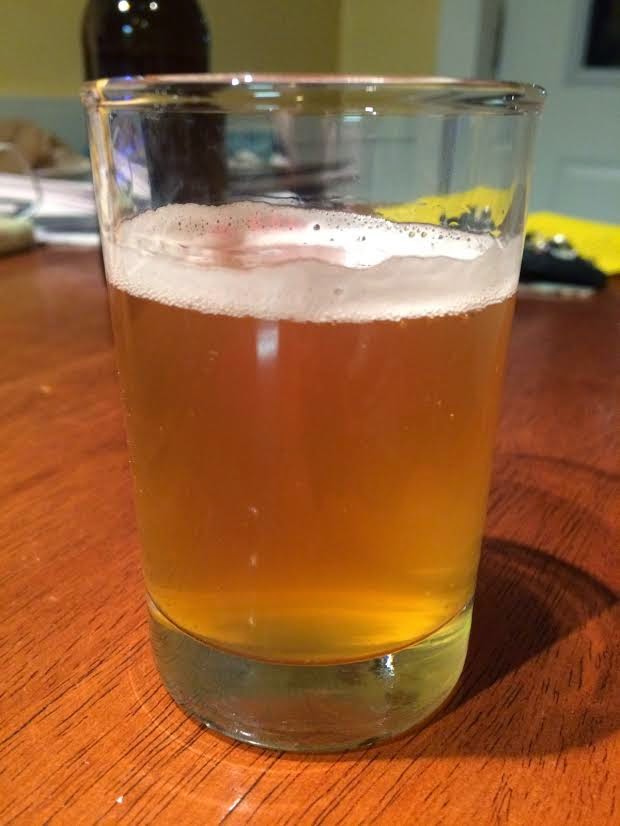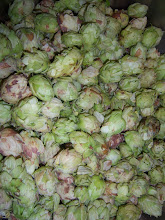
I spent the weekend contemplating what I learned from brewing this
year’s round of fresh hop beers, mostly because I came across a bottle of
Deschutes Chasin’ Freshies at Belmont Party Supply and felt compelled to pick it up. Yes, it
was a bit past its  prime—hop grassiness had started to cut through the more
interesting hop flavors—but it was still certainly enjoyable. And my introspection led me to consider not only what I had learned this year, but also over the last couple of years of fresh hop brewing. Generally, I brew four or so fresh hop beers a year in my pursuit to retain the self-proclaimed title of Fresh Hop King of Ohio, which started in 2012 during a speculative moment similar to this one. Unlike most of my other posts, however, someone actually read that post and called me out on it, hence the small-scale competitions of the last two years. So what did I learn this year?
prime—hop grassiness had started to cut through the more
interesting hop flavors—but it was still certainly enjoyable. And my introspection led me to consider not only what I had learned this year, but also over the last couple of years of fresh hop brewing. Generally, I brew four or so fresh hop beers a year in my pursuit to retain the self-proclaimed title of Fresh Hop King of Ohio, which started in 2012 during a speculative moment similar to this one. Unlike most of my other posts, however, someone actually read that post and called me out on it, hence the small-scale competitions of the last two years. So what did I learn this year?
prime—hop grassiness had started to cut through the more
interesting hop flavors—but it was still certainly enjoyable. And my introspection led me to consider not only what I had learned this year, but also over the last couple of years of fresh hop brewing. Generally, I brew four or so fresh hop beers a year in my pursuit to retain the self-proclaimed title of Fresh Hop King of Ohio, which started in 2012 during a speculative moment similar to this one. Unlike most of my other posts, however, someone actually read that post and called me out on it, hence the small-scale competitions of the last two years. So what did I learn this year?
1) Hop volume matters. One pound of fresh hops is not enough for a good
or interesting fresh hop beer. Yes, you can adulterate your recipe with dried hops for the
60 minute addition to compensate for a lack of fresh hops, or mix dried hops in
throughout the hopping schedule, but that is not really a fresh hop beer, is
it? While getting multiple pounds of fresh hops is both difficult and expensive, it is worth
it. I’m generally not a brewing purist, but when it comes to Fresh Hop beers, I am. The Bike Path Fresh Hop beer I made this year with almost 4 pounds of hops is the
closest I’ve come to getting that gamey wild hop character you find in the best
fresh hop beers, although it lacked the reciprocal hop flavor and aroma intensity I also desire. Next year, I’d like to combine a couple of different hop varieties in the same batch as a way to expand my repertoire—all of my previous fresh hop beers have been
single-hop beers.
2) Simplify your malt bill. I learned some of this during last year’s round of fresh hop beers, but this
year confirmed it. Want to use a whole bunch of caramel malt? Then you should
probably just throw those fresh hops in the trash can right now. Unless you have multiple pounds of fresh hops to use in your beer. This  year
Pilsen was the base malt for all four of my fresh hop beers; I also used White Wheat
in three, and MFB Vienna in the fourth as an experiment carrying over from last
year. One beer did have a pound of MFB Pale, but that was because I ran out of
Pilsen, and that was the most appropriate malt on hand. I did try a pound of
acidulated malt the Smith Hop, which I will try again next year; the bright
carbonation and slight tartness from the acidity really brought the beer
together as a whole. And while I have no scientific justification for what I’m
about to say, the acidity seemed to accentuate the subtle hop flavors—it was saison-like in brightness and acidity, and this was accentuated by the subtle hop flavors. Focus on the base malt, and cut out the darker and sweeter malts.
year
Pilsen was the base malt for all four of my fresh hop beers; I also used White Wheat
in three, and MFB Vienna in the fourth as an experiment carrying over from last
year. One beer did have a pound of MFB Pale, but that was because I ran out of
Pilsen, and that was the most appropriate malt on hand. I did try a pound of
acidulated malt the Smith Hop, which I will try again next year; the bright
carbonation and slight tartness from the acidity really brought the beer
together as a whole. And while I have no scientific justification for what I’m
about to say, the acidity seemed to accentuate the subtle hop flavors—it was saison-like in brightness and acidity, and this was accentuated by the subtle hop flavors. Focus on the base malt, and cut out the darker and sweeter malts.
year
Pilsen was the base malt for all four of my fresh hop beers; I also used White Wheat
in three, and MFB Vienna in the fourth as an experiment carrying over from last
year. One beer did have a pound of MFB Pale, but that was because I ran out of
Pilsen, and that was the most appropriate malt on hand. I did try a pound of
acidulated malt the Smith Hop, which I will try again next year; the bright
carbonation and slight tartness from the acidity really brought the beer
together as a whole. And while I have no scientific justification for what I’m
about to say, the acidity seemed to accentuate the subtle hop flavors—it was saison-like in brightness and acidity, and this was accentuated by the subtle hop flavors. Focus on the base malt, and cut out the darker and sweeter malts.
3) Yeast selection matters. I initially started with “pick a
clean, neutral yeast,” but thought better of it. This year, I used US-05 for
three of the four fresh hop beers. While I know that US-05 is supposedly a clean,
neutral yeast, all three of these beers had a similar subtle off-flavor  in the
finish that I found off-putting. The fourth beer went the opposite route; I
used a blend of custersianus, bruxellensis Trois, and Lactobacillus
that is currently my house yeast, mostly because it was on hand when a couple
of pounds of Nugget fresh hops magically came my way. It made a great beer, but
by the time it got into the bottle, the Brettanomyces
had decimated anything that might be identified as fresh hop derived, which was
something of a tragedy, since those Nugget were the nicest fresh hops I had
ever laid my hands on. Still, there are a lot of options between the two poles
of neutral and wild; last year, I used ECY08 Saison Brasserie, WLP510 Bastogne,
and Wyeast 1272 American Ale II in fresh hop beers. While the ECY08 might have
been a bit too expressive of a yeast choice, the WLP510 paired well, and the
Wyeast 1272 is a better clean, neutral American yeast selection that
US-05, at least to my palate.
in the
finish that I found off-putting. The fourth beer went the opposite route; I
used a blend of custersianus, bruxellensis Trois, and Lactobacillus
that is currently my house yeast, mostly because it was on hand when a couple
of pounds of Nugget fresh hops magically came my way. It made a great beer, but
by the time it got into the bottle, the Brettanomyces
had decimated anything that might be identified as fresh hop derived, which was
something of a tragedy, since those Nugget were the nicest fresh hops I had
ever laid my hands on. Still, there are a lot of options between the two poles
of neutral and wild; last year, I used ECY08 Saison Brasserie, WLP510 Bastogne,
and Wyeast 1272 American Ale II in fresh hop beers. While the ECY08 might have
been a bit too expressive of a yeast choice, the WLP510 paired well, and the
Wyeast 1272 is a better clean, neutral American yeast selection that
US-05, at least to my palate.
in the
finish that I found off-putting. The fourth beer went the opposite route; I
used a blend of custersianus, bruxellensis Trois, and Lactobacillus
that is currently my house yeast, mostly because it was on hand when a couple
of pounds of Nugget fresh hops magically came my way. It made a great beer, but
by the time it got into the bottle, the Brettanomyces
had decimated anything that might be identified as fresh hop derived, which was
something of a tragedy, since those Nugget were the nicest fresh hops I had
ever laid my hands on. Still, there are a lot of options between the two poles
of neutral and wild; last year, I used ECY08 Saison Brasserie, WLP510 Bastogne,
and Wyeast 1272 American Ale II in fresh hop beers. While the ECY08 might have
been a bit too expressive of a yeast choice, the WLP510 paired well, and the
Wyeast 1272 is a better clean, neutral American yeast selection that
US-05, at least to my palate. For ease of reference, here are links to the fresh hop beers I’ve brewed over the last four years:
Bike Path Fresh Hop 2014 Fresh Hop King of Ohio winner 2014
Sour Fresh Hop w/ Nugget 2014
Brewer’s Gold Fresh Hop 2014
Smith Hop 2014
Last Wild Fresh Hop 2013
Brewer’s Gold Fresh Hop 2013
Smith Hop 2013 Fresh Hop King of Ohio winner 2013
Cascade Fresh Hop 2013
Last Wild Fresh Hop 2012
Smith Hop 2012
Wild Wet Hop 2012
Wild Wet Hop 2010
(4/13/2015)