Friday, August 7, 2009

38. Dark Horse Crooked Tree IPA

Crooked Tree IPA is from the Dark Horse Brewery in Marshall, MI; we had this beer on tap at the South Park Tavern during their Dark Horse brewing special event. As you can see, they had Dark Horse glasses, and we got to take them home with us. New free glassware is always a plus, especially when it comes in pint glass form.

Crooked Tree has floral and citrus hop aromas that cover over the minimal malt sweetness of the nose, and a cloudy topaz color with a generous head that laces the glass nicely. It has a light malt sweetness at the start, moving into an abundantly bitter middle with some low level floral hop flavors, and a lingering bitter finish. With a smooth, substantial mouthfeel and a well-carbonated body, Crooked Tree does have the substance to carry the large hop load present in the beer and that emerges in the slight curling at the back of the tongue. There is a solid hop bitterness present throughout the beer, one that, while sharp, is also pleasant and enjoyable. Crooked Tree is certainly much more of an American than a British IPA; while it would benefit from more hop flavors in the body of the beer, the aroma and bitterness levels are well-balanced.

From Dark Horse’s website: “Inspired by West Coast I.P.A.’s, but brewed with Michigan style. The Crooked Tree is heavily dry hopped to give it a big aroma of pine and citrus. The flavors are big, yet very balanced between fresh hops and malt. Often described as "grapefruit" our hops give this beer an excellent fruit flavor that finishes dry, crisp, and clean. It will pour a nice deep copper color with a bit of haziness. Because of our almost patented ‘Intense Transfer Methods’ our Crooked Tree has won several medals in the India Pale Ale category.”

ABV: 6.0%

(8/7/2009)

Thursday, August 6, 2009

37. Bürger Classic Beer

Bürger Classic Beer is made by the Hudepohl-Schoenling Brewing Company in Cinncinati, OH. Founded in 1885, Hudepohl Brewing joined with Schoenling Brewing in 1986. This combined brewing company then was bought and sold a couple more times, before being purchased by Gregory Hardman in 2006 (Hardman also owns Christian Moerlein Brewing Company). At least this is what I have pieced together thus far—I couldn’t find a website for the company—the closest I could get was the listing for it on BeerAdvocate. However, I did stumble across several other interesting bits of information that I document below.

Bürger is a crystal clear pale straw yellow—see photos. It had a good head with the initial pour that quickly faded. There is the classic lightly musty lager smell; otherwise a clean crisp malt nose. Bürger begins smooth and slightly sweet with some light graininess in the middle before ending crisp with a touch of bitterness. At mid-bottle (or, more appropriately, mid-can), with some warmth, the musty smell is replaced by a malty smell, and the flavor develops some toasted, malty notes. With a light, crisp mouthfeel, it compares well to PBR or other similar domestics—a good example of an American lager with a nice balance of sweet and dry. And at $2.95 a six-pack, it was worth every penny.

The history of Bürger, and of the Hudepohl-Schoenling Brewing Company, seems the normal narrative of conglomerate brewing: smaller breweries are purchased by larger breweries until only a couple own everyone else. The Wikipedia entry for Hudepohl Brewing Company maps a good portion of this out, observing that “As of April, 2008 the Hudepohl building on Gest street still stands, though it appears to be in the process of being deconstructed. The smoke stack bearing the Hudepohl name is still in great condition. As of November 2008, Little Kings, Hudy Delight and the Moerlein brands remain in production under contract brewing arrangements with other regional brewers. On May 20, 2009 Mr. Hardman announced the relaunch of Bürger Beer. He plans to relaunch Hudepohl 14-K in late 2009 or early 2010.”

Then there is this post on the ruins of the Hupepohl Brewery from Queen City Discovery, detailing some local information about the abandoned brewery, and providing both old television commercials from the ’70’s and photos and commentary on the exploration of the abandoned brewery itself. All in all, pretty interesting. There are also two follow up posts, Climbing to the Top of Mt. Hudepohl and Hudepohl Brewing Company: Tour 3.

There is also BrewtifulCincy, which documents “Cincinnati's Rich, Frothy Brewing History,” although this blog is more interested in the whole of Cinncinnati's brewing history.

(bonus points awarded to the first person to correctly identify what Elli is doing behind the glass)

We also have Abandoned, which documents abandoned historical buildings. Click on the photographs link to see all of the pictures from the abandoned Hupepohl Brewery. There is some cross over between the photos here and the ones in the Queen City Discovery posts; one of the links on the second Queen City Discovery post is how I ended up on the particular site.

Finally, there is this news story from 2005 about an attempt to sell the old Hudepohl smokestack. Seriously. Like that thing's gonna be easy to move and install somewhere else.

(8/6/2009)

Wednesday, August 5, 2009

36. Murphy’s Draught Style Stout vs. Guinness Draught Style Stout

Today we're having our first annual widget draught can drink off: our contestants are Murphy’s Draught Style Stout and Guiness Draught. Murphy’s is brewed by Murphy Brewing in Cork, Ireland, and Guiness is brewed by St. James Gate Brewery in Dublin, Ireland.

Murphy’s begins with a dry burnt malt nose and a rich, creamy off-white head, created in part by the widget can. With an opaque brown color and a thick, creamy head, Murphy’s is visually pleasing. Guinness begins in much the same way; there is a light burnt malt nose that is almost crisp and a rich, creamy white head via the widget can. There is a bit more visual settling with Guinness once it is in the glass—you can see it settle out from head to fluid—but other than that, both look quite similar. As well, Guinness's body is slightly darker, the head is a bit lighter colored, and it is less opaque.
Aroma and Appearance Advantage: Guinness

In terms of taste, Murphy’s starts with a creamy roasted and slightly chalky malt sweetness; there is not much of a distinctive middle, and it finishes with a burnt bitterness. In comparison, Guinness begins with a bit of a smoother and sweeter flavor; while there is limited middle, as with Murphy’s, there is less burnt taste until the finish.
Flavor Advantage: Murphy’s

Murphy’s has a thin, smooth, and creamy mouthfeel—there is not a lot of sweetness, but the creaminess is similar to a milk stout. The dryness makes this drink and taste like a lighter stout with less body. While Guinness is much the same, there is a slightly heavier mouthfeel and more overall malt flavor with Guinness.
Mouthfeel Advantage: Guinness

Murphy’s flavor profile makes this is an easy drinking beer good for an entire evening of potable pursuits. While Guinness is in much the same category, it is the intangibles that set them apart. The visual qualities of Guinness are good, but the light chalky dryness of Murphy’s gives it the overall advantage in terms of flavor and tasty enjoyment.
Overall Advantage: Murphy’s

Both of their websites are pretty much useless for finding any interesting information about the beer in question--it’s mainly glitzy advertising copy with no substance. The Guinness website did offer this: “There’s a little bit of magic in every expertly crafted drop of Guiness. There are six distinct features that make our beer stand out from all the others. There’s our roasted barley, the extra hops we use, the special yeast, our maturation process, the famous creamy head and lastly the supremely skillful craft of our brewers. Arthur Guiness started the St. James’s Gate brewery in Dublin back in 1759. Today at our St. James Gate Brewery, there are nine key steps in our brewing process to achieve the enjoyment of our Guiness beer.” So while it tells me about how happy they are with their brewing process in general, it gives me nothing really of interest or merit—just bland advertising copy. Just once I’d like to see the brewery that tells me they use an “unspecial yeast.” That would be the day.
Website Advantage: Nobody wins with these websites.

Murphy’s
ABV: 4.0%

Guinness
ABV: 4.2%

(8/5/2009)

Tuesday, August 4, 2009

35. New Belgium La Folie Sour Brown Ale

New Belgium Brewery is in Fort Collins, CO. New Belgium is a great great brewery. New Belgium doesn’t distribute to Ohio. That sucks. That sucks big. I tried all summer to win one of their Tour de Fat bikes using my dad’s address, but I failed miserably. We first had La Folie on tap at the Map Room in Chicago; when we were getting ready to open this one, my mouth started puckering even before I opened it.

La Folie has a tart, sour, sweet hard candy smell; there are also slight adhesive and medicinal hints within the nose. With a tan light head and a deep mahogany color mixed with red highlights, La Folie is almost as pretty as it smells. And that’s before getting to the flavor. It begins with a slight fruity carbonation fizz before moving into a sour candyish flavor with slight medicinal notes; as it runs across the palate, it continues to pucker the tongue, and ends with some astringency that lingers in the back of the mouth. The mouthfeel is watery, slick, and puckery. And yes, we understand that that may be a contradiction in terms. Welcome to the beauty that is sour beers. Overall, a delightfully tart and delicious beer—so so tart and yummy. As well, it is most certainly part of the dirty band aid family of beers. This beer is pretty much a guaranteed Top 10 best beer of the year—the sourness and tartness appeals to both our palates, and the overall taste and flavor range is exquisite.

From the New Belgium website: “La Folie Wood-Aged Biere, is our original wood-conditioned beer, resting in French Oak barrels between one and three years before being hand bottled, numbered and corked for your enjoyment. Brewmaster, Peter Bouckaert, came to us from Rodenbach – home of the fabled sour red. Our La Folie emulates the spontaneous fermentation beers of Peter’s beloved Flanders with sour apple notes, a dry effervescence, and earthy undertones.”

ABV: 6.0%

(8/4/2009)

Monday, August 3, 2009

34. Southern Tier Imperial Mokah

“Dessert in a glass.”

Our second beer from Southern Tier Brewery, located in Lakewood, NY.

Southern Tier Imperial Mokah has a rich chocolate and roasted coffee nose—very delicious smelling—and a dark coffee-colored body with a creamy tan head. The beer begins with a sweet malt flavor, bringing with it chocolate and vanilla notes that range across the palate, before finishing with a dark coffee bitterness with lingers on the back of the tongue. Mokah has a creamy, rich, and thick mouthfeel; there is some alcohol warmth in it, especially at the end. While a delicious and interesting beer, Mokah could be a bit more stout-y: it could use more burnt and roasted notes to build the body and lessen the sweetness, and the bitterness that is apparent tastes like it is from the coffee only.

(someone can't resist hamming for the camera)


From Southern Tier’s website: “Mokah: a stout brewed with chocolate & coffee. When empirical and creative impulses collide, the result is often timeless. The classic utility-art aesthetic of the coffee maker is an example of design and engineering working in concert. It is through similar cooperation that the simple bitter cocoa bean is transformed into a sweet treat. As scientists, our brewers utilize their materials to exacting standards. As artists, they couldn’t resist the temptation to combine two of our highly acclaimed Blackwater Series Imperial Stouts: Jahva and Choklat. Alone each is perfect, but together as Mokah they are an inimitable expression of two of the world’s most sought after flavors. Enjoy Mokah stout with – or as – your favorite dessert!”

ABV: 10.9%
Color: 221ºL
OG: 27º P
Malt: 2-Row pale malt, 2-Row barley, Caramel, Chocolate & Black malts, Roasted barley, and Barley flakes
Other Ingredients: Jamaican roasted coffee and bittersweet Belgian chocolate
Hops: Chinook, Willamette, Cascade & Columbus

(8/3/2009)

Sunday, August 2, 2009

33. Sierra Nevada 2008 12th Release Harvest Wet Hop Ale

Located in Chico, CA, Sierra Nevada Brewery is one of the older and more successful craft breweries in the U. S., operating since 1980. Unfortunately for all of you (and myself, since I always love waxing nostalgic), I can think of no clever or interesting stories regarding my long sordid relationship with Sierra Nevada. I will say that for many a year, Sierra Nevada was the only interesting American thing to drink on the East Coast--that short stubby bottle was easy to spot and easier to drink. Thank goodness the rest of the country finally caught up with Sierra Nevada.

Sierra Nevada Harvest has a sweet malty nose with not a lot of hop aroma to it—there is a bit of a piney smell to it, but not a lot else. The caramel, toffee color and the thick off-white head accentuate each other nicely. Harvest starts with a caramel malt front and moves into a piney and citrusy hop flavor with some lower levels of bitterness before finishing with a roasty flavor and a touch of bitterness. It has a creamy, smooth mouthfeel with some crispness provided by the carbonation. Overall, a decent beer, but not as exciting as some of the other Sierra Nevada products.

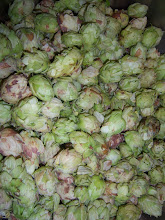
From the Sierra Nevada website: “The cornerstone of our Harvest series is the beer that started the modern-day fresh hop ale phenomenon in America, our original Harvest Ale. Created in 1996, Harvest Ale features Cascade and Centennial hops from the Yakima Valley in Eastern Washington. These hops are harvested and shipped as ‘wet’ un-dried hops—the same day they are picked—to our brewery in Chico where our brewers eagerly wait to get them into the brew kettle while their oils and resins are still at their peak.”

From the bottle (see picture to the left): “Our Harvest Ale was the first American beer ever brewed with 100% fresh-picked ‘wet’ hops. In just one day, we harvest hops in Yakima, WA, ship them that night to our brewery in Chico, CA and then rush then to the brew kettle as they are unloaded at dawn the next day. This extraordinary effort creates a beer with unmatched aromatics of pine and citrus with layers of spicy sweet notes that hop fanatics like us dream of all year. Enjoy!”

ABV: 6.7%
Malts: Two-Row Pale and Caramel
Bittering Hops: Centennial
Finishing Hops: Cascade & Centennial
IBU: 60-65
OG: 16.5º P
FG: 4.0º P

(8/2/2009)

Saturday, August 1, 2009

32. Great Divide Fresh Hop Pale Ale

Just to drive home my rambling inanities from yesterday, we’re doubling up on the Great Divide. That technically makes this our Great Divide double-double, or, for those of you who don’t appreciate my confusing math, our fourth Great Divide beer. Just remember, that still makes my math better than the W’s. What did the W stand for, anyway? Wanker? But I digress. While beating up W, especially at this point in history, is tantamount to beating up a red-headed step child, it is really neither clever nor interesting. And it is certainly much MUCH less interesting than talking about beer.

Great Divide’s Fresh Hop Pale Ale has a bready, biscuity nose mixed with grassy hop aromas. It is a burnished copper color with a mild ivory head. The strong malty front—in turn bready and a dry biscuity, but well rounded on the palate—moves into some hop bitterness accompanied by some slighty sharp grassy and piney hop flavors along with some resiny aftertaste that continues to sit on the tongue into the finish, which ends crisp with a little lingering resinous bitterness. Malt flavors rise in conclusion of beer as it warms; it has a soft chewy mouthfeel and a well-balanced body that, like the 15th Anniversary, is reminiscent of the malt profile of the Denver Pale Ale (DPA). Fresh Hop has fresh and clean hop flavors without excess bitterness; there are more of the flavor aromatics from the hop oils present than the bittering qualities present, which makes for a hoppy but very drinkable beer. This is literally the beer that brought me back to Great Divide (well, not this exact one in particular)—yes, it’s the last lingering bottle from last year, but it still contains much of the fresh hop characteristics that made it enjoyable last fall.

From Great Divide’s website: “Fresh Hop Pale Ale is brewed with fresh, whole cone hops from the Pacific Northwest. We ship these ‘wet’ hops to Denver overnight and brew shortly after harvest, imparting an intensely grassy hop aroma and citrus hop flavor in a medium-bodied ale.”

ABV: 6.1%
IBU: 55

(8/1/2009)